50,000 Miles in My Rivian R1S
My Rivian R1S hits 50,000 miles this week and still looks like delivery day. A look back at the wait, the build, the road trips, and what has held up.
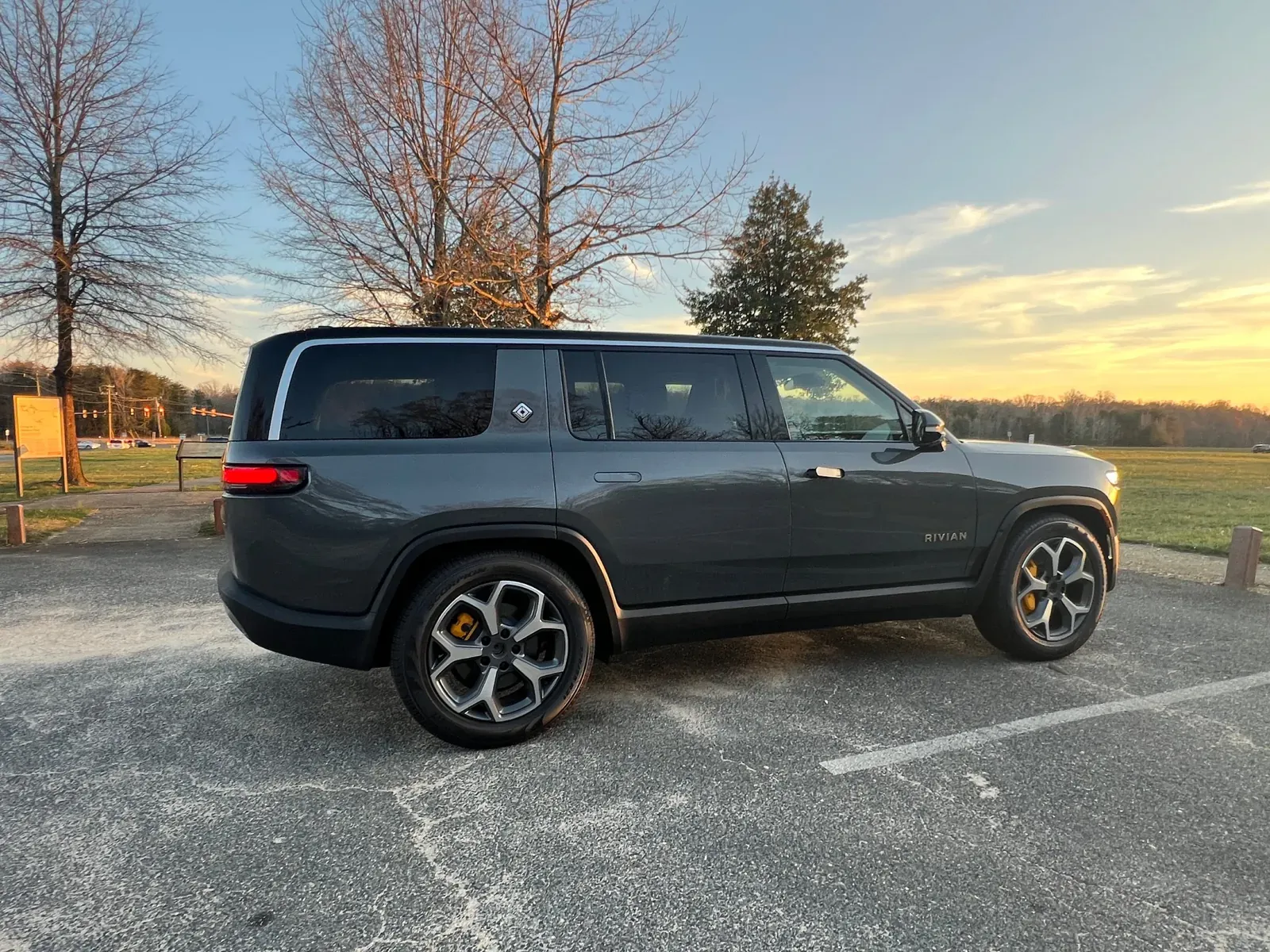
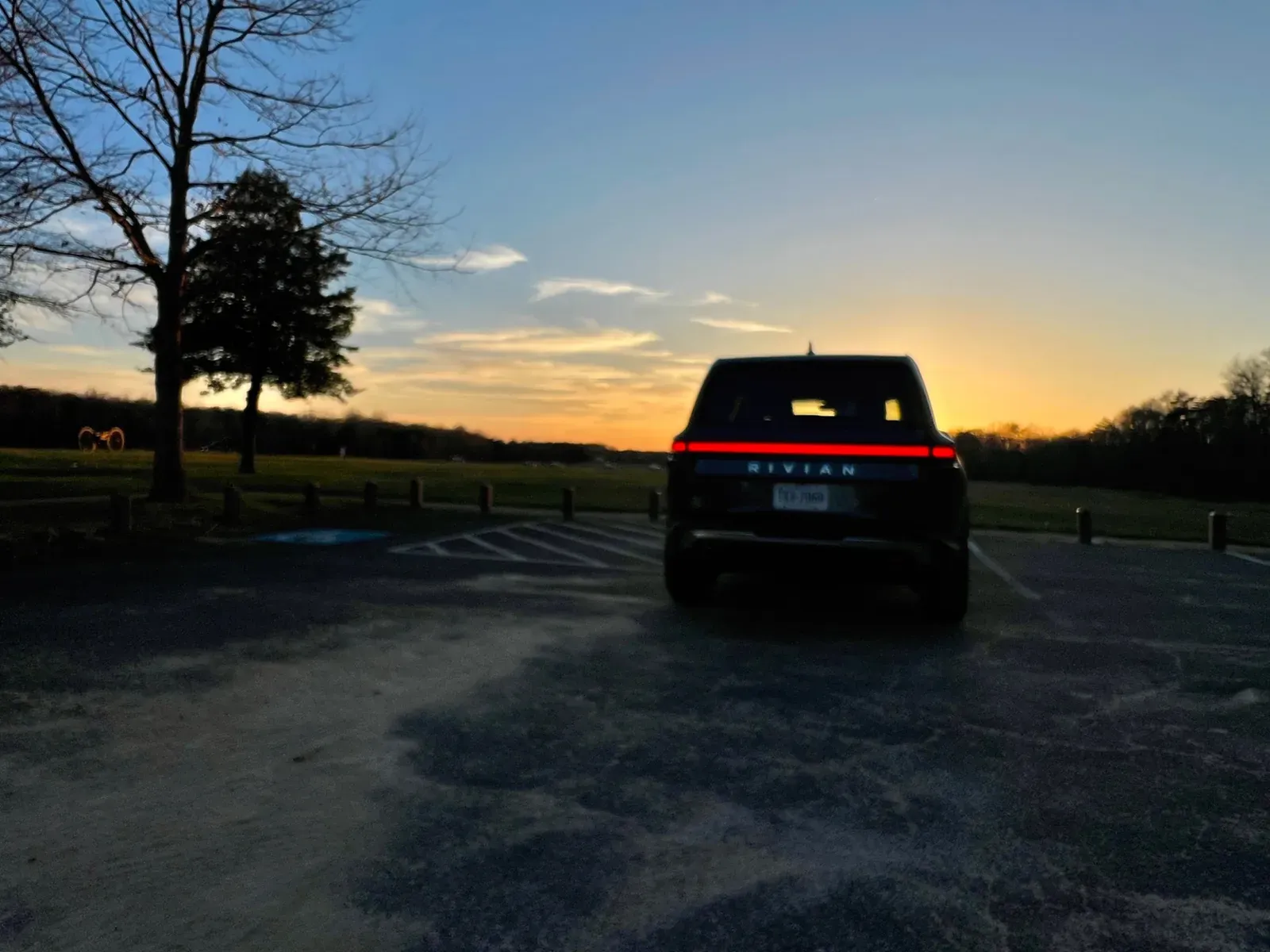
This week my Rivian R1S rolls past 50,000 miles, and it still looks like the day I picked it up.
That is not something I expected to write about a vehicle that has been packed to the roof, driven across state lines more times than I can count, and lived in by a family on long road trips. Fifty thousand miles is usually when a car starts to show its age. Mine hasn’t. So this feels like the right moment to look back at the wait, the build, and what has held up.
Two and a half years of waiting
I put my preorder in early: August 2021, before a single R1S had reached a customer. I finally took delivery in March 2024.
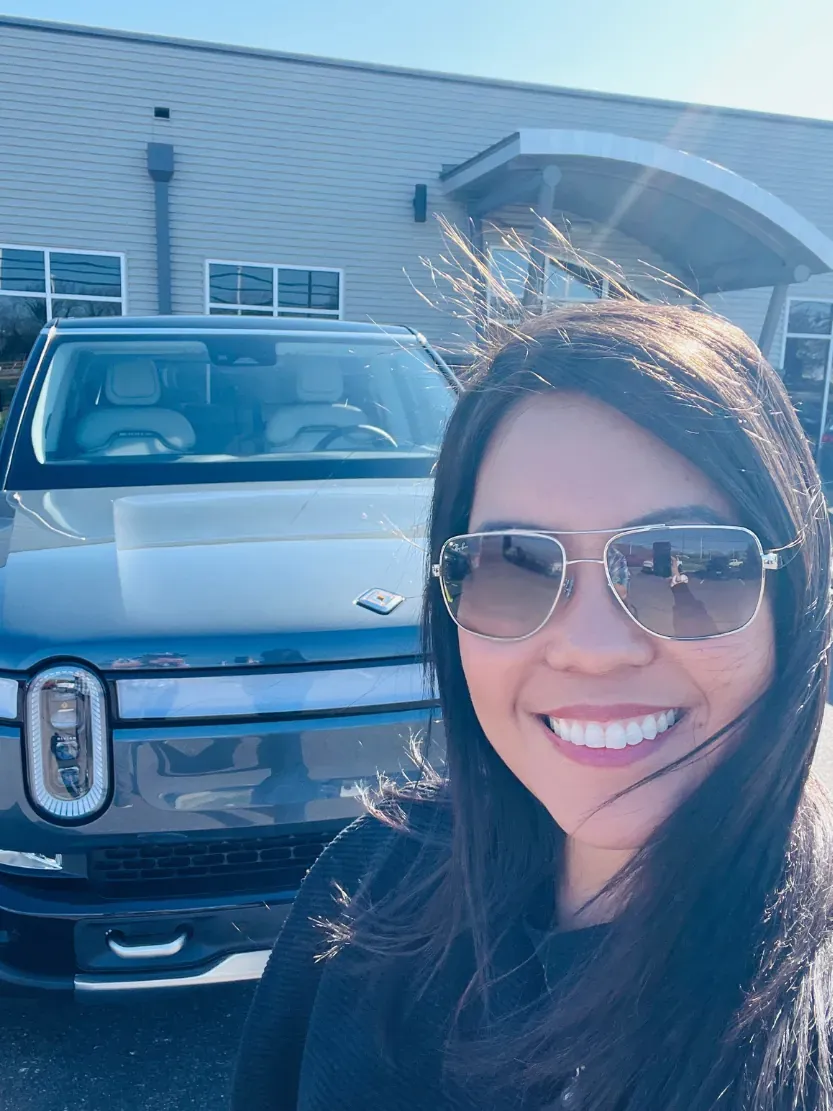
Delivery day, March 2024. Worth the wait.
That is roughly two and a half years of watching forums, refreshing my account page, and wondering whether I had made the right call on a company that was still figuring out how to build cars at scale. Anyone who preordered in that era knows the feeling. I was still waiting when I wrote about whether electric vehicles are a practical choice in late 2023.
The timing turned out to be oddly good. March 2024 was the same month Rivian owners got access to Tesla’s Supercharger network, with Rivian sending out adapters for free. I started my ownership with a much bigger charging map than the people who took delivery before me.
My build
| Model | R1S, first generation |
| Drive | Quad-Motor AWD, Large pack battery |
| Paint | El Cap Granite |
| Interior | Ocean Coast + Dark Ash Wood |
| Package | Adventure Package |
| Extras | Onboard air compressor, removable Bluetooth Camp Speaker |
A word about the color. El Cap Granite is a deep grey with a hint of blue that shifts with the light, and Rivian no longer offers it. It was retired in early 2026 and replaced by a warmer shade called Half Moon Grey. I’m biased, but I think I got the better grey, and I love that you can’t order it anymore.
The Quad-Motor setup is the other thing I would not trade. One motor at each wheel, 835 horsepower, 908 lb-ft of torque, and a 0–60 time of about three seconds in a three-row SUV. Rivian has since moved on to a second generation, but the original quad still feels like the one that made the company’s reputation.
An interior that still looks new
If I had to pick one favorite thing, it is the interior finishes.
The Adventure Package cabin pairs perforated vegan leather seats, heated and ventilated up front, with natural-grained ash wood across the dash and doors and a headliner made from recycled microfiber. Ocean Coast is the light interior, and I was warned that a light interior and a family road-trip vehicle do not mix.
Fifty thousand miles later, it still looks new. Rivian designed these surfaces to resist stains and smudges, and in my experience that claim has held up through real use: road trips, full loads, and everything that comes with them.

The first drive home, an hour from the service center. The Ocean Coast interior looks the same today.
The quality is what I notice every time I get in. It feels like a space someone designed with care instead of a parts-bin cabin with a big screen bolted on.
Amazing to drive
The R1S is a big vehicle that does not drive like one.
Part of that is the quad-motor system. With a motor at each wheel, power goes exactly where the grip is, and it arrives instantly. The battery sits low in the floor, so the weight is underneath you instead of up high, and the body stays flatter in corners than a three-row SUV has any right to.
The other part is the air suspension. It raises and lowers the ride height depending on the drive mode, so the same vehicle can sit low and efficient on the highway and then lift itself for a rough road. Add strong regenerative braking, which lets you do most of your driving with one pedal, and long days behind the wheel are far less tiring than they used to be.
It is quiet, it is quick, and after 50,000 miles I still look forward to driving it.
Built for road trips
It has been with us on many road trips, and this is where the R1S earns its keep.
It seats seven across three rows. Fold the second and third rows flat and you get about 105 cubic feet of cargo space, plus a front trunk where an engine would be and a hidden compartment under the rear floor. We have packed it to its fullest, and it swallowed everything.
Nala, our pup, comes along too, buckled into a car seat of her own in the back.

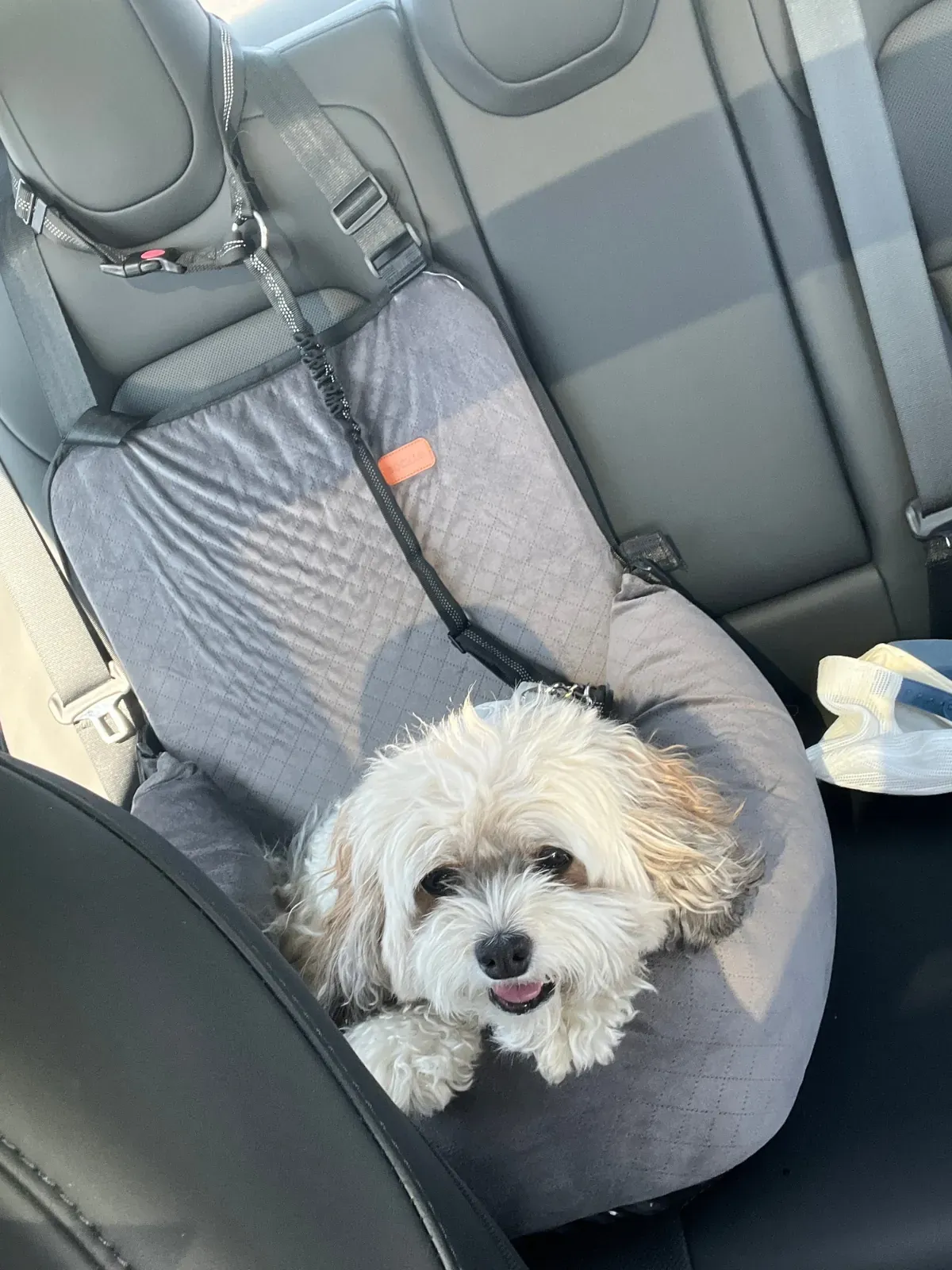
The most important passenger, settled in for the drive.
Our most recent trips have taken us to Cape Cod, to Destin, Florida, and to Charleston. That is north up the coast, deep into the Gulf, and down to the Lowcountry: three very different drives, and the R1S was a pleasure on every one of them.
Charging on the road is easier than people assume. Rivian’s trip planner routes you through fast chargers automatically, including Rivian’s own Adventure Network and, with an adapter, more than 15,000 Tesla Superchargers across North America. The Quad-Motor R1S is rated at about 321 miles of range, so on a road trip the charging stops tend to line up with the stops you would be making anyway.
Connect+ is worth it for the Wi-Fi alone
I spend my working life around connected devices, so I am skeptical of subscriptions that get added after you have bought the hardware. Connect+ is the exception.
It is Rivian’s optional connectivity plan, currently $14.99 a month or $149.99 a year. It adds streaming apps on the center display, satellite map views, the voice assistant, and live camera views. All nice to have.
The reason I pay for it is the in-vehicle Wi-Fi hotspot. It supports up to eight devices at once, which on a family road trip means tablets, laptops, and phones all online for hours without anyone burning through a phone plan or fighting over a single tethered connection. Compared with what a standalone mobile hotspot costs each month, it pays for itself.
For a vehicle we take on long trips, that one feature changed what the back seats are like.
The little things
Some of my favorite features are the ones that sound like gimmicks until you need them.
- The onboard air compressor. It is built into the cargo area with its own hose, so you can air tires down for a trail and back up for the highway, or top off bikes, balls, and air mattresses, without hunting for a gas station pump.
- The Camp Speaker. A weatherproof Bluetooth speaker that lives in a dock at the front of the center console and charges while it sits there. Pull it out at a campsite or a picnic table and it doubles as a lantern.
- Software updates. The R1S gets new features over the air, the way a phone does. The vehicle I drive today does more than the one I picked up in March 2024.
On the first-generation R1S the compressor and the Camp Speaker came with the vehicle. Rivian later turned both into paid add-ons on most trims, which makes me appreciate them a little more.
Service that comes to my house
Rivian’s mobile service is amazing, and it deserves its own mention.
In 50,000 miles I haven’t needed much service at all. There are no oil changes, and the routine schedule is mostly a tire rotation and inspection every 7,500 miles. When that comes due, I book it in the app and a Rivian technician comes to my house and does the work right out front.
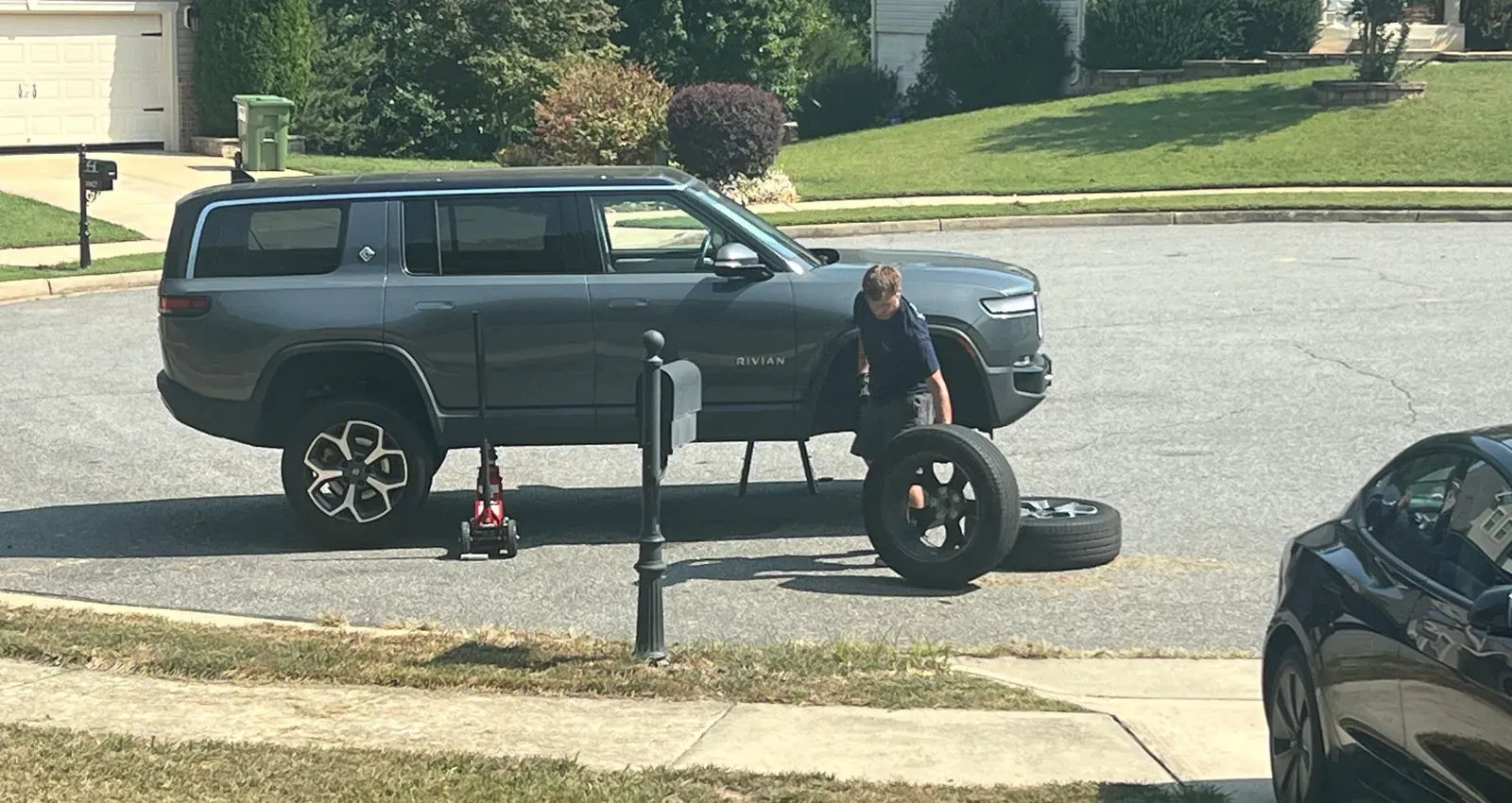
Tire rotation day, as seen from my front window.
No dropping the car off, no waiting room, no arranging a ride home. After years of dealership service departments, it still feels like a small luxury every time.
Rivian Care, and what comes next
I recently bought Rivian Care, Rivian’s extended coverage plan: five more years with unlimited miles. At the rate we drive, unlimited miles is the part that matters. It picks up where the factory warranty leaves off, and it means the next stretch of road trips comes without repair-bill anxiety.
And yet. Rivian’s newest driver-assistance feature, Point to Point, ties hands-free driving into navigation so the vehicle follows a whole route through city streets, intersections, and highways. It is rolling out to second-generation R1 vehicles and the new R2. My first-generation R1S is not eligible, and this is the one thing a software update can’t give it.
I also happen to hold a day-one preorder for the R2. So I might go ahead and make the switch. Saying goodbye to this one would be hard, but I have waited on a Rivian preorder before, and it worked out pretty well.
50,000 miles in
I waited two and a half years for this vehicle, and I would do it again.
It drives beautifully, it holds everything we throw in it, and after 50,000 miles the interior still looks like it did on delivery day. The color I love is gone from the configurator and the quad-motor I chose has been replaced by a newer one, and I still wouldn’t change a thing about my build.
Here’s to the next 50,000, whether they happen in this R1S or in whatever Rivian comes next.

Written by Angel Piontek
I came to technology by way of real estate, and I’ve spent my career explaining each to the other. Today I lead marketing for connected property technology, including the access, energy, water, and security systems behind apartment communities and rental homes. I’m an early adopter by nature and a pragmatist by experience: I care about devices that work together and quietly do their job. Off the clock, I’m learning to print on two gorgeous vintage letterpresses.
Full bio →